Interface / Voices
Clear View
Clear the screen.
Let the story land.
0.83 is about what you see and hear at the moments that count. When a life ends, the end card stands beside your hero and the narrator reads the Saga properly. While you play, voices stop repeating themselves, and the cards at the top of the screen stay out of the middle, however much is going on.
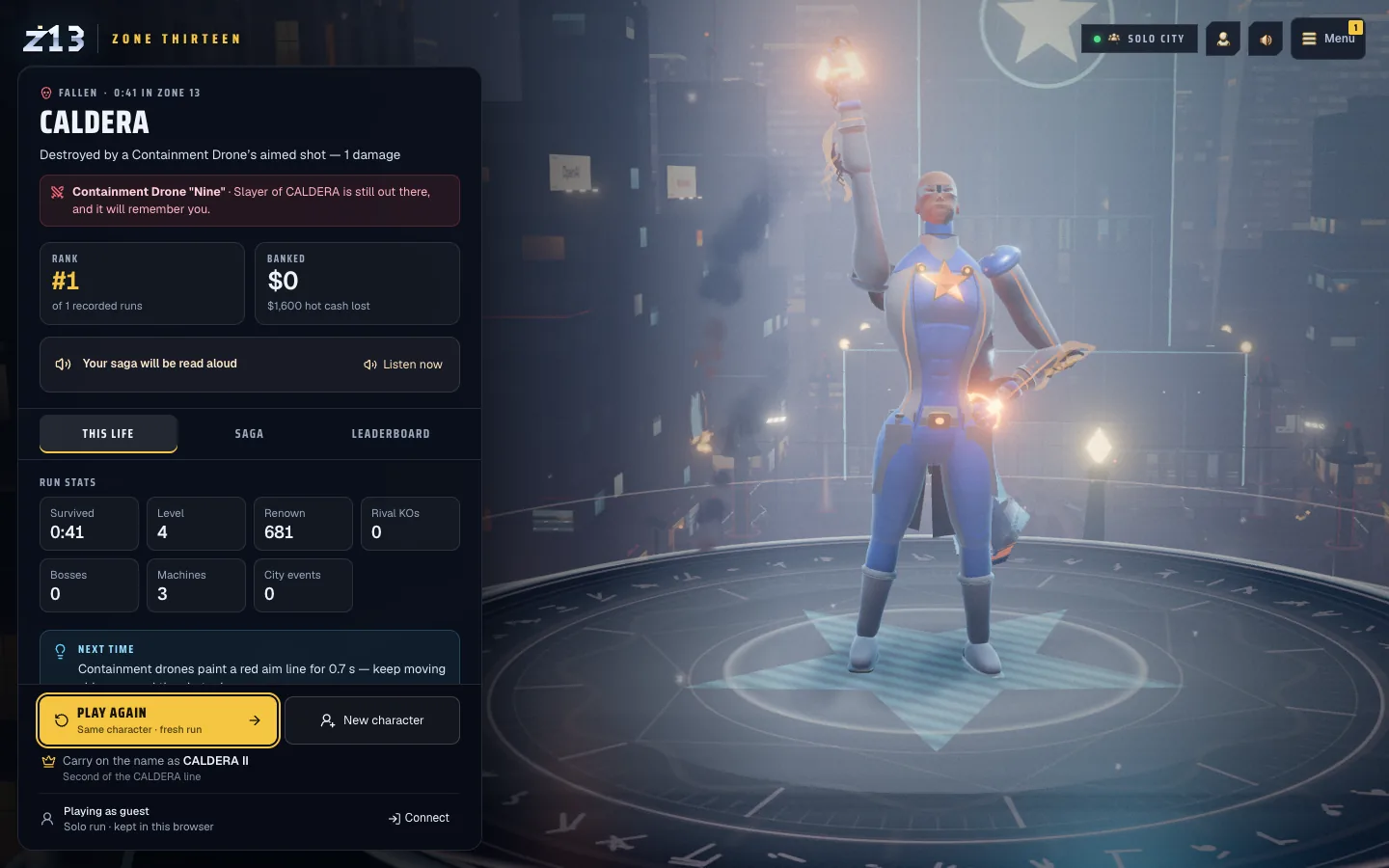
01 / The end card
Beside the hero. Not on top of them.
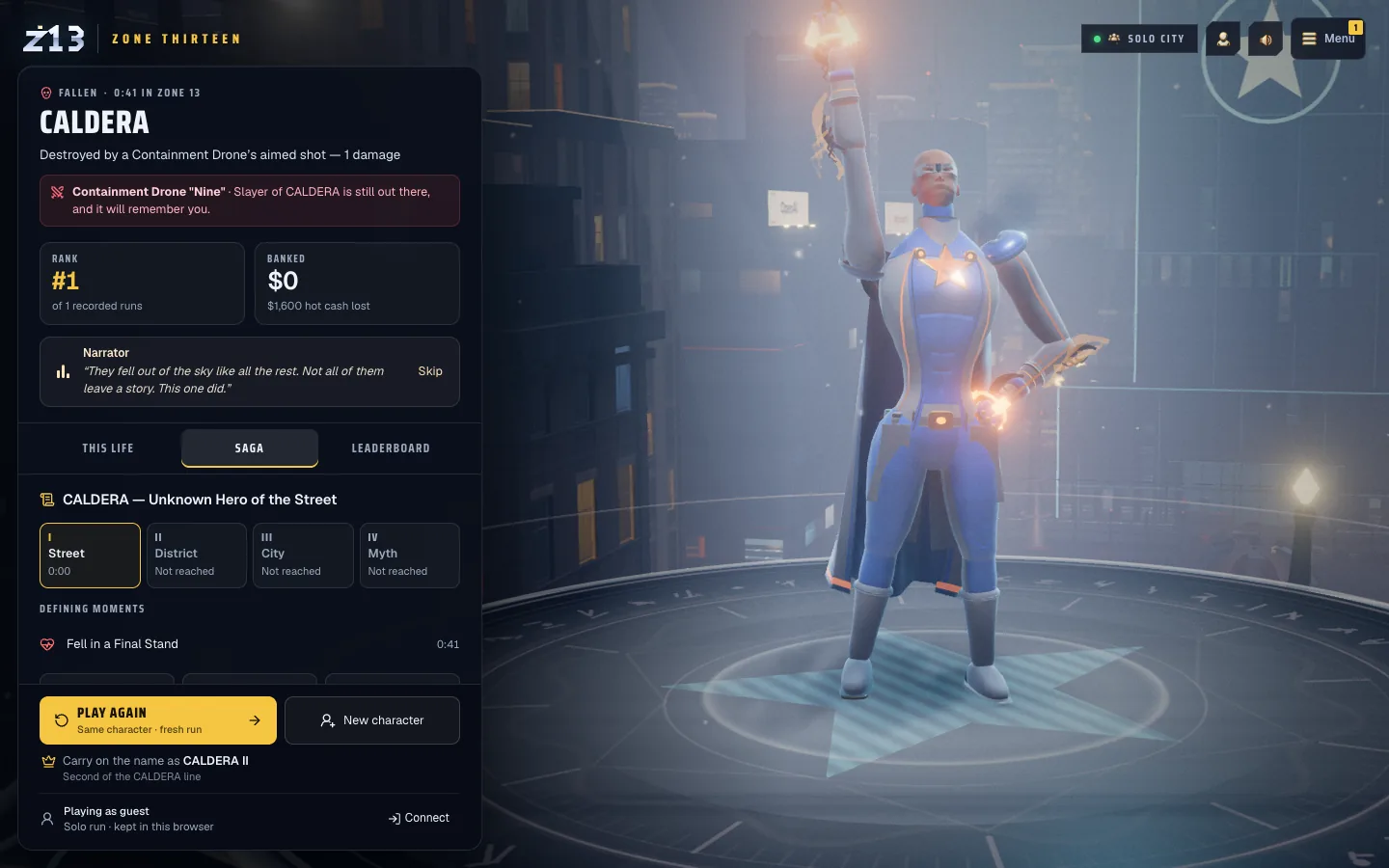
When a life ends, the card now takes a column at the side and the camera frames your hero in the space that is left. The top says how you fell and who will remember you, then your rank and your cash. Tabs open the rest: This life, the Saga and the Leaderboard. Everything scrolls in one place, and Play again never scrolls away.
Forty-seven seconds: with CALDERA's health set to 1 through a development hook and two patrols spawned beside the hero (a development hook), a Containment Drone's shot starts the Final Stand. No attack is made, the ten seconds run out, and the new end card opens beside the fallen hero. After the death sting the narrator begins; the Saga tab is opened with a click and the story is read through as one piece, the bar on the card showing each sentence. Before the film, XP to rank 4 and $1,400 hot cash were granted through development hooks (the drafts answered with their recommended card), three sentries were spawned and fought with ordinary attacks (Tab, keys 1 to 3), and health was refilled through a development hook. Captured at the released 0.83.0 source in a local solo city (the game's own solo mode, served by a development server on this machine, not z13.online), as a guest who never signs in, in desktop Chrome with the complete interface visible. The character was set up through a development hook. Turn on the player's sound to hear the game.
What the card showsTop to bottom, at any screen size+
- The outcome
- Fallen, Retired a Legend or Run ended, with your time in Zone 13; the name; the cause of death in words; the enemy that will remember you; then rank and banked cash as two large figures.
- This life
- Run stats, the final hits you took with their damage, a matching tip for next time, and this life's legacy.
- Saga
- The chapters you reached and when, the defining moments, banked cash, hot cash lost and the life's time, with Copy saga.
- Leaderboard
- The recorded runs, ten to a page. Your own run stays pinned at the bottom when it is off the page.
- The footer
- Play again (same character, fresh run), New character and Carry on the name never scroll away. Enter plays again unless a control has focus; L opens Legends.
- Every size
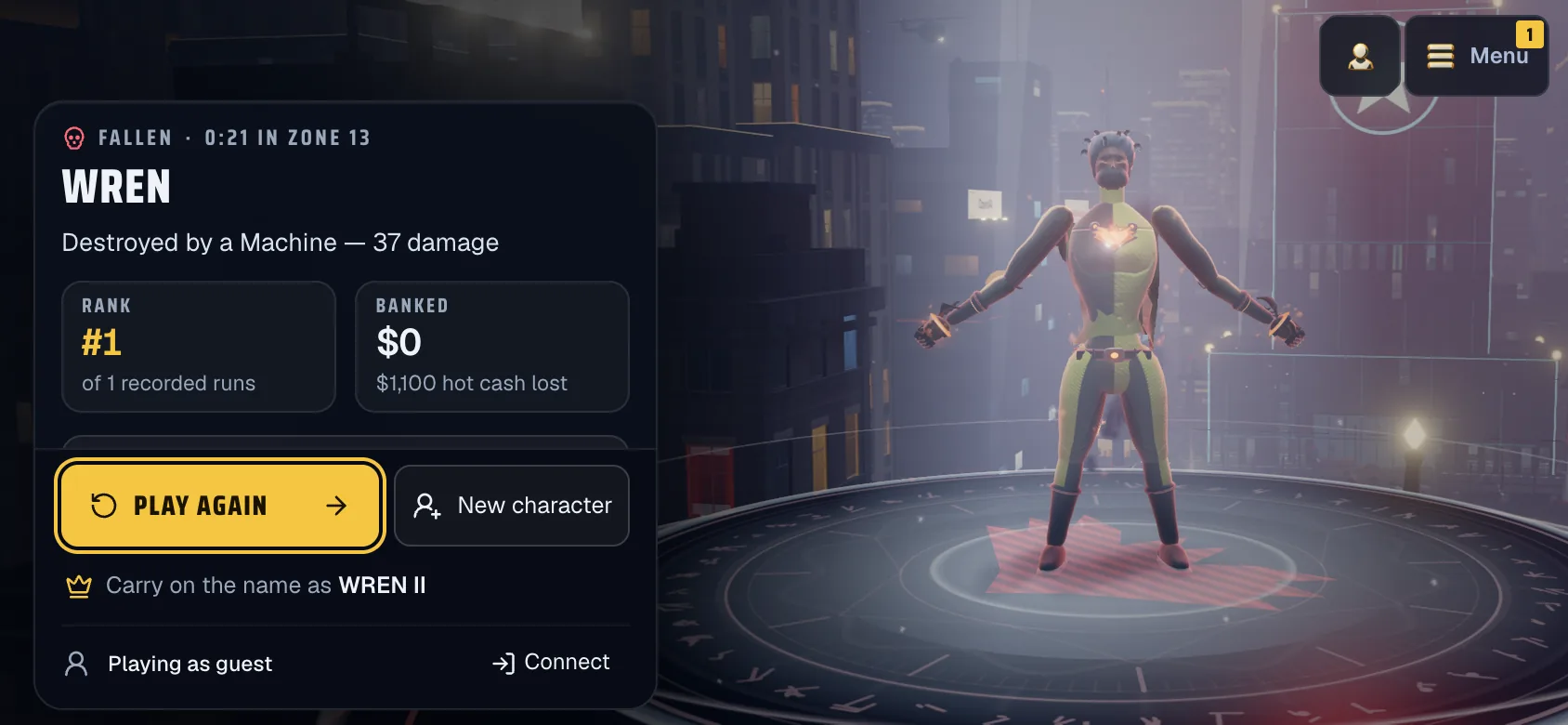
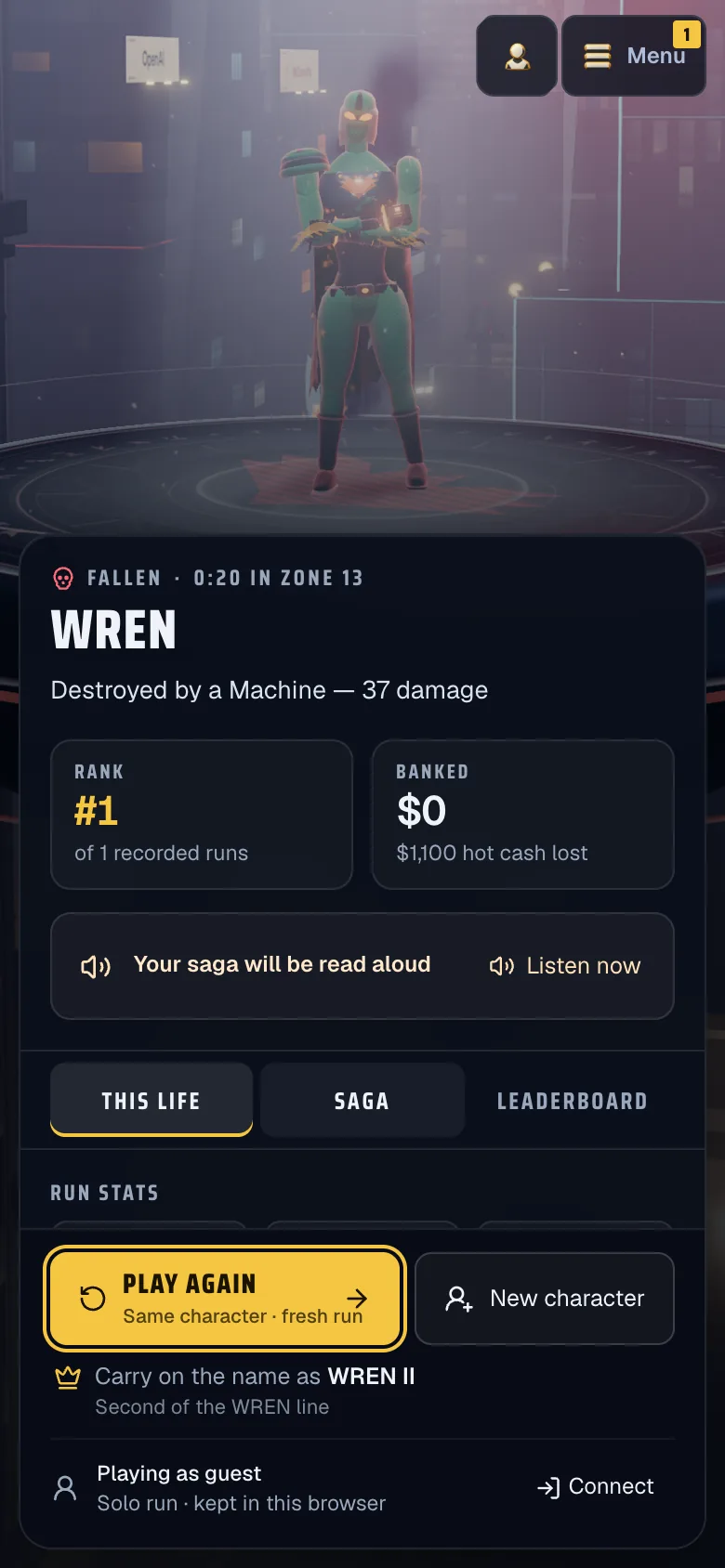
- A column of 340 to 500 px on desktop and in landscape, a bottom sheet on portrait phones. No section has a fixed height, so nothing is cut off.
02 / The Saga, read aloud
One story. Read once, then quiet.
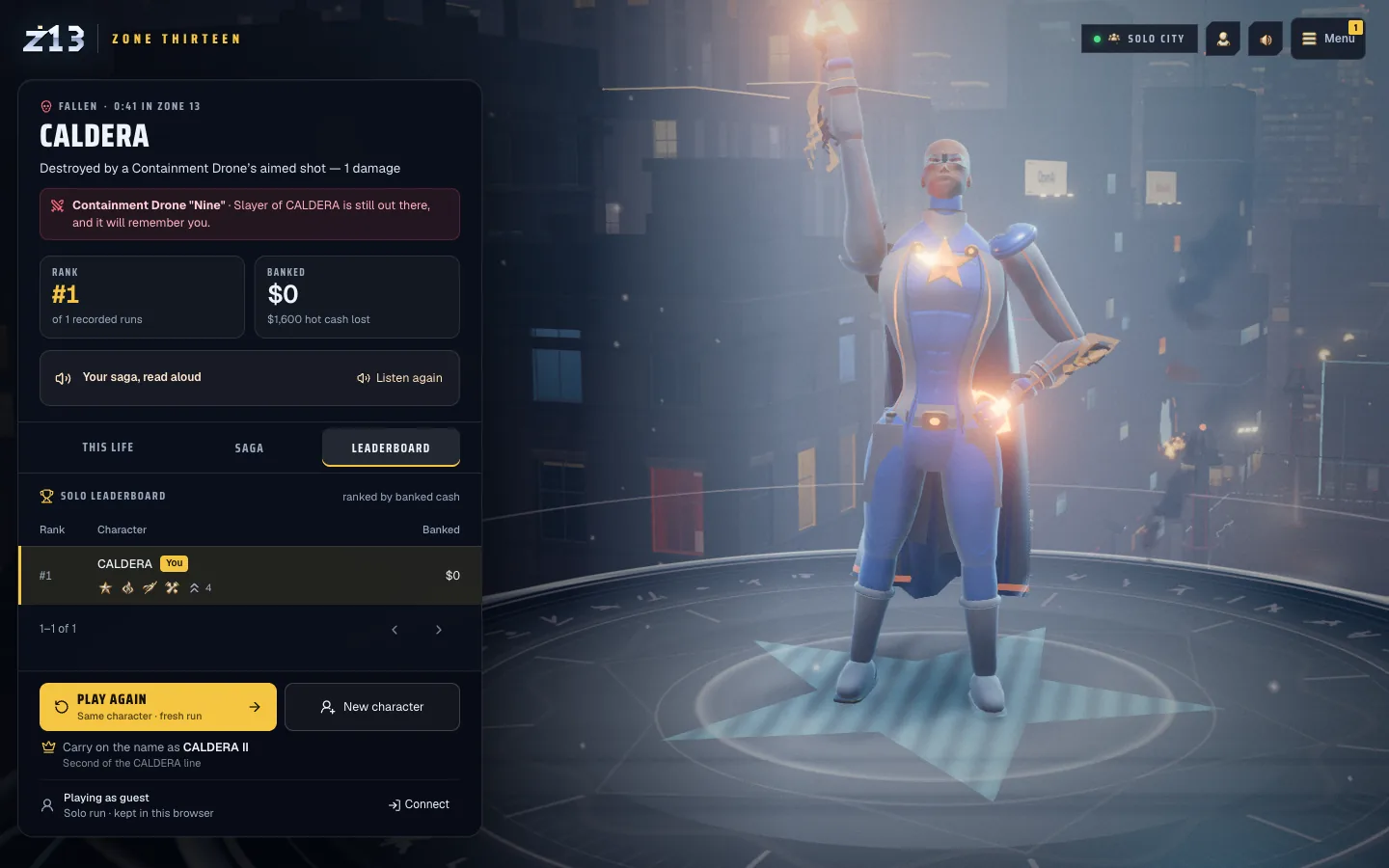
The narrator used to start over the death sting, stall between sentences and keep talking into your next life. Now it waits for the sting, loads the whole story first and reads it as one piece with natural pauses. The card shows the sentence being read, with Skip and Listen again, and the moment you play again, the voice stops.
Sixteen seconds, continuing the same take directly after the previous film: the Leaderboard tab, then This life, then Listen again starts the Saga over. Play again is clicked mid-sentence: the reading stops with the card and the same character starts a fresh life in silence from the narrator. Earlier in the take, XP, hot cash and health were set through development hooks. Captured at the released 0.83.0 source in a local solo city (the game's own solo mode, served by a development server on this machine, not z13.online), as a guest who never signs in, in desktop Chrome with the complete interface visible. The character was set up through a development hook. Turn on the player's sound to hear the game.
How the reading worksThe Saga on the end card+
- When it starts
- Once the card has been up 1.6 seconds and 7.4 seconds have passed since the knockout, so the death sting lands first. A retirement has no knockout and starts after 1.6 seconds.
- Whole or not at all
- Every fragment is loaded before the first word. A missing one is skipped; one still loading after 6 seconds ends the attempt rather than reading late.
- Paced
- Back to back on the audio clock, with 0.9 seconds after the opening, 0.55 between lines and 0.85 before the close, under one continuous duck of the music. Announcements wait while it reads.
- Yours to control
- Listen now, Skip and Listen again. If the Dialogue volume is off, the card tells you how to turn it on, and a reading that could not play says so.
- It belongs to the card
- Play again, New character or Carry on fades it out at once, and a reading that has not started never starts. Mute, a zero Dialogue slider or a hidden tab stop it too.
03 / No more repeating voices
Said once. Then it waits.
Every voice line now has a window in which it is never said again. A chase where you keep breaking line of sight no longer says "Visual lost" every few seconds, Hunt moves are announced at most every five minutes, Marshal Rook taunts less often, and a squad no longer echoes the same shout in two voices.
Repeat windowsThe same line, at most once per window+
- Police
- 90 seconds. Marshal Rook: 60 seconds for the same line, and a taunt every 40 seconds instead of every 24.
- The Hunt
- 300 seconds, so a champion that relocates every two minutes is announced at most every five.
- The Rise and city events
- 60 seconds.
- Bosses and champions
- 20 seconds for a boss line, 45 for a champion.
- The Fixer
- 30 seconds. Anything else: 45.
- Barks
- The same words at most once in 30 seconds in any voice, and one bark per situation (spotted, hunting, fleeing) every 8 seconds across a whole squad.
04 / A protected view
Busy city. Clear middle.
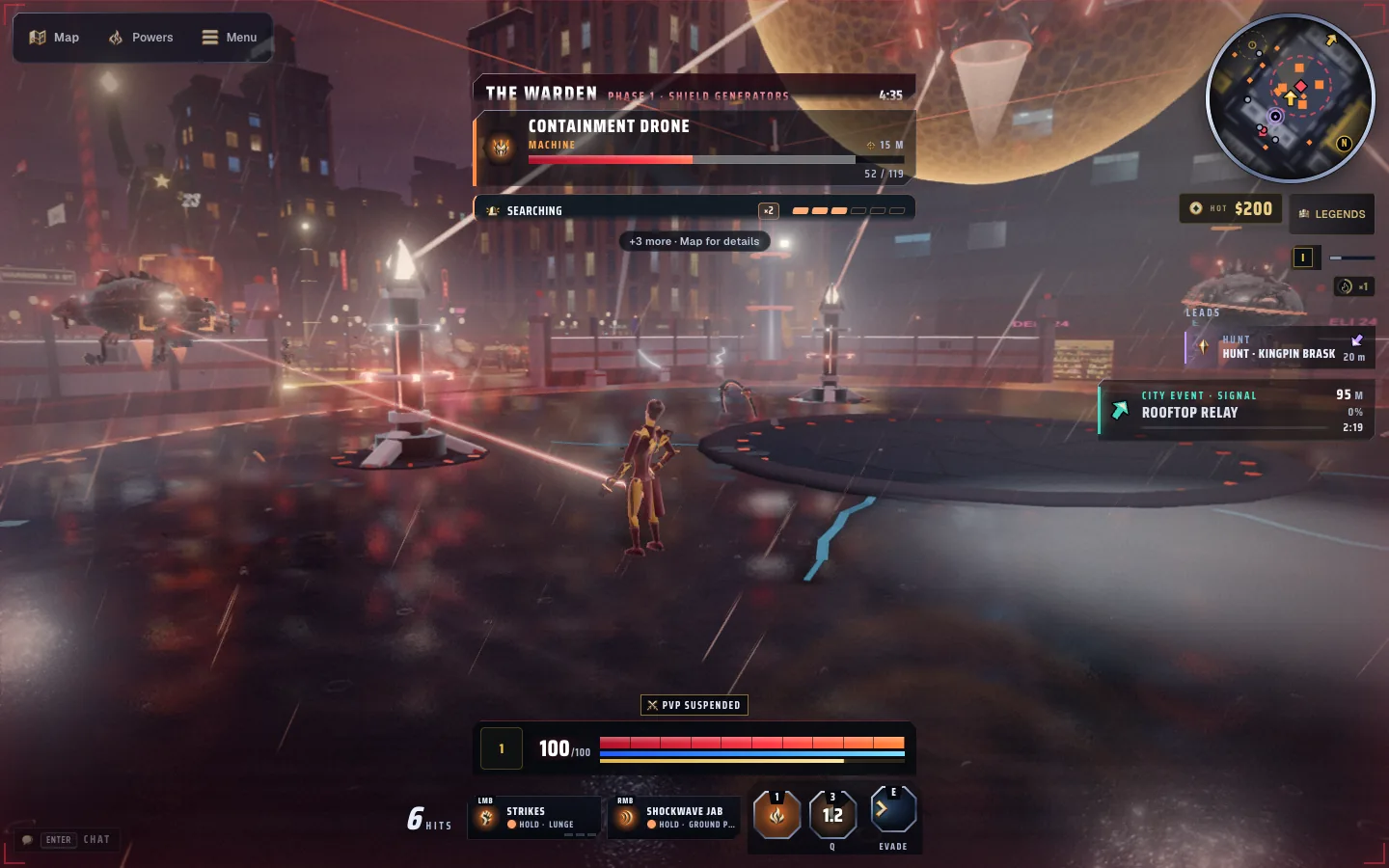
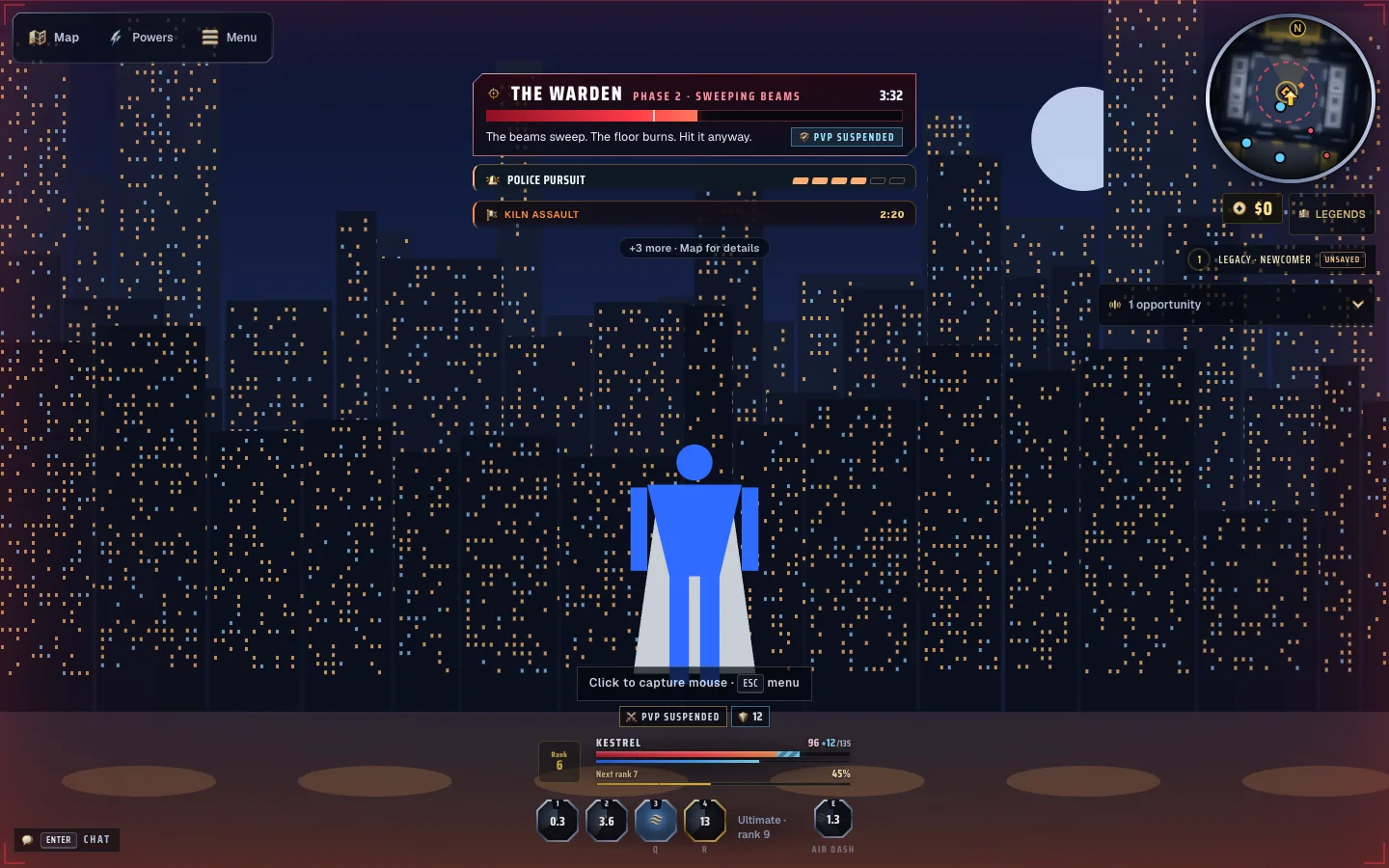
The cards at the top of the screen used to stack: a boss fight during a pursuit, a Hunt and a Blood Moon could bury the boss bar halfway down. Now they live in a fixed band. The fight you are in leads, the next cards fold to a one-line header, and the rest are counted on a single line. The middle of the screen stays with the world.
Twenty-one seconds with NOCTIS, a villain: a police search is under way (six civilian-harm reports were recorded for NOCTIS through a development hook; no civilian is harmed on camera) and the Warden has been woken through a development hook. NOCTIS lands in the arena and the Warden's bar leads the top band while the search folds to one line. A Hunt for Kingpin Brask is posted and the Blood Moon is raised, both through development hooks: they are counted on the "+3 more · Map for details" line and the band keeps its height. NOCTIS then fights a Containment Drone with ordinary attacks (Tab, keys 1 and 3). Health was refilled through a development hook and NOCTIS was placed outside the arena through a development hook before the take. Captured at the released 0.83.0 source in a local solo city (the game's own solo mode, served by a development server on this machine, not z13.online), as a guest who never signs in, in desktop Chrome with the complete interface visible. The character was set up through a development hook. Turn on the player's sound to hear the game.
How the band decidesRanked, not stacked+
- Its size
- On desktop, 22% of the height (170 to 240 px) from where the stack starts, never ending below 32% of the screen. On touch, never below 46% in portrait or 50% in landscape. Banners and tips are placed from its bottom edge, so they are bounded too.
- The order
- An action you can take now, then the fight you are in (boss, colossus, tower, Cinderfront, crown, robbery), then the police, a setpiece, the Hunt, the Blood Moon, alerts, the operation and your standing. A disclosure you opened outranks them all.
- Full, folded, counted
- The highest cards keep their full layout, the next fold to a 30 px header, and the rest are counted on "+N more · Map for details". Once one card folds, no lower card is shown larger. The attack callout and the target frame are never folded.
- Measured
- In the UI lab's crowded scene at 1440×900 the stack ended at 556 px (62%) before 0.83 and at 268 px (30%) after; on a 390×844 phone, at 370 px (44%).
The details
Everything in v0.83.
A new end card
The end card is a column beside your fallen hero on desktop and in landscape (between 340 and 500 px wide, 42% of the screen width), and a bottom sheet from 34% of the height on portrait phones (19% on short ones), with the memorial camera framing the hero in the space that is left. The top tells you how you fell, in words, which enemy will remember you, your rank and your banked cash. Below it, sticky tabs open This life (run stats, the last hits you took with their damage and a tip for next time), the Saga and the Leaderboard. Everything scrolls in one place, nothing scrolls inside anything else, and Play again, New character and Carry on the name sit in a footer that never scrolls away. Enter plays again unless a control such as a tab, Skip or a leaderboard row has focus.
Your Saga, read properly
The narrator now waits for the death sting to finish: the reading starts once the card has been up 1.6 seconds and 7.4 seconds have passed since the knockout (a retirement starts after 1.6 seconds). Every fragment is loaded before the first word, and a fragment still loading after 6 seconds ends the attempt rather than reading late. The story plays as one smooth piece with natural pauses (0.9 seconds after the opening, 0.55 between lines, 0.85 before the close) under one continuous duck of the music, and no announcement cuts into it. A bar on the card shows the narrator's state and the sentence being read, with Listen now, Skip and Listen again; if the Dialogue volume is off, the card says so. The reading belongs to the card: Play again, New character or Carry on stops it at once instead of letting it talk over your next life.
No more repeating voices
A line is never said again within its category's window: police 90 seconds, the Hunt 300, Marshal Rook 60, the Rise and city events 60, a boss 20, a champion 45, the Fixer 30, anything else 45. A chase where you keep breaking line of sight no longer says "Visual lost" on every flip, Hunt moves are announced at most every five minutes, and Marshal Rook taunts every 40 seconds instead of every 24. Barks are keyed by their words, so the same shout is said at most once in 30 seconds in any voice, and a squad shares one bark per situation (spotted, hunting, fleeing) every 8 seconds instead of echoing itself.
A protected view
The cards at the top of the screen (police pursuit, Blood Moon, Hunt, setpieces, standing, prompts, boss and colossus bars, alerts, the operation bar, the attack callout and the target frame) live in one band that can never grow into the middle. On desktop it is 22% of the height, between 170 and 240 px, and never ends below 32% of the screen; on touch it never ends below 46% in portrait or 50% in landscape. Cards are ranked by what matters now: an action you can take, then the fight you are in, then the police, a setpiece, the Hunt, the Blood Moon, alerts, the operation and your standing. The highest keep their full layout, the next fold to a 30 px one-line header, and anything that still does not fit is counted on a single "+N more · Map for details" line. A disclosure you opened outranks them all.
Client only
0.83.0 changes only the client, on protocol 45: no protocol, rule, server or data change, and the room keeps running 0.80.7. In the UI lab's crowded scene at 1440×900 (a boss fight, a pursuit, Kiln Assault, a Hunt, the Blood Moon and standing at once), the top stack ended at 556 px (62% of the height) before and at 268 px (30%) after. Not observed live yet: the narration on real speakers, physical phones, Safari and Firefox, and several players.